This series documents my cybersecurity homelab on a single Proxmox node. I use it to learn networking, Windows identity, SIEM telemetry, detection work, attack simulation, honeypots, malware-analysis isolation, and automation.
The goal is not to build many random virtual machines. The goal is to build a small but realistic lab where each network has a clear job, and each path between networks can be explained.
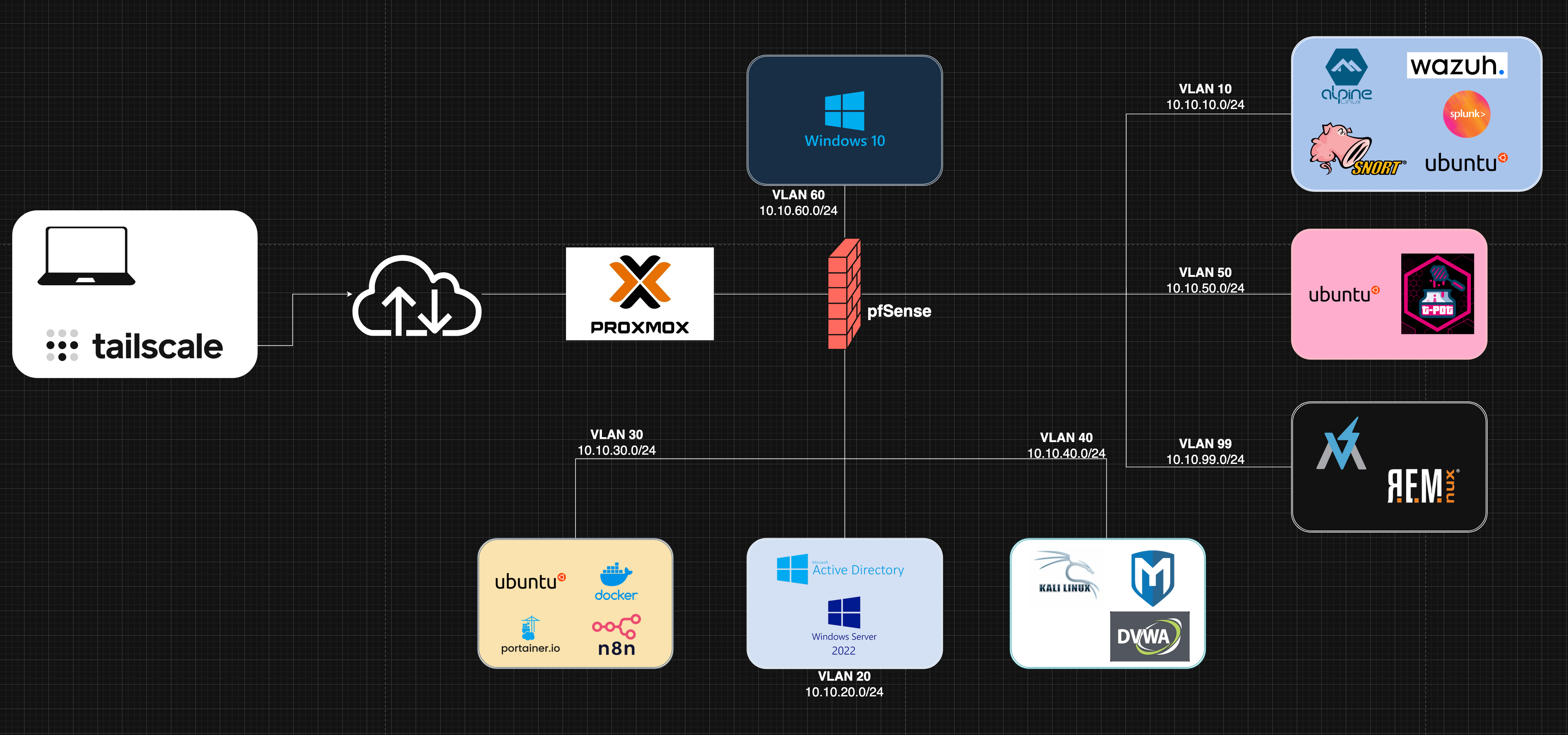
Series Map
| Part | Focus |
|---|---|
| 1 | Proxmox, pfSense, and the first internal bridge |
| 2 | Alpine jumpbox and safe access to pfSense |
| 3 | VLANs, gateways, and early DHCP |
| 4 | Docker, Portainer, n8n, and macvlan |
| 5 | Kali and Metasploitable in the pentest segment |
| 6 | Wazuh SIEM foundation and first log sources |
| 7 | Snort IDS, T-Pot, and honeypot telemetry |
| 8 | Tailscale remote access behind CGNAT |
| 9 | Isolated malware-analysis segment |
| 10 | Active Directory, DNS, DHCP, and domain join |
| 11 | Final pfSense firewall rules and segmentation hardening |
VLANs
| VLAN | Subnet | Purpose |
|---|---|---|
| LAN | 10.10.1.0/24 | first access, jumpbox, and emergency management |
| 10 | 10.10.10.0/24 | SIEM and monitoring systems |
| 20 | 10.10.20.0/24 | defence services: Active Directory, DNS, and DHCP |
| 30 | 10.10.30.0/24 | Docker host, Portainer, automation, and containers |
| 40 | 10.10.40.0/24 | Kali and intentionally vulnerable targets |
| 50 | 10.10.50.0/24 | honeypots and attack telemetry |
| 60 | 10.10.60.0/24 | Windows clients and endpoint telemetry |
| 99 | 10.10.99.0/24 | isolated malware-analysis machines |